Bitcoin's $40,000 Projection: A Statistically Improbable Scenario
Market analysts suggest that a drop in Bitcoin to the $40,000 mark would represent a statistically almost unprecedented event. Mean reversion models indicate that such a scenario would fall within the 0.4 percentile, far beyond typical market corrections.
By Carlos "Emérito" López Loverahace 7 horas2 min read
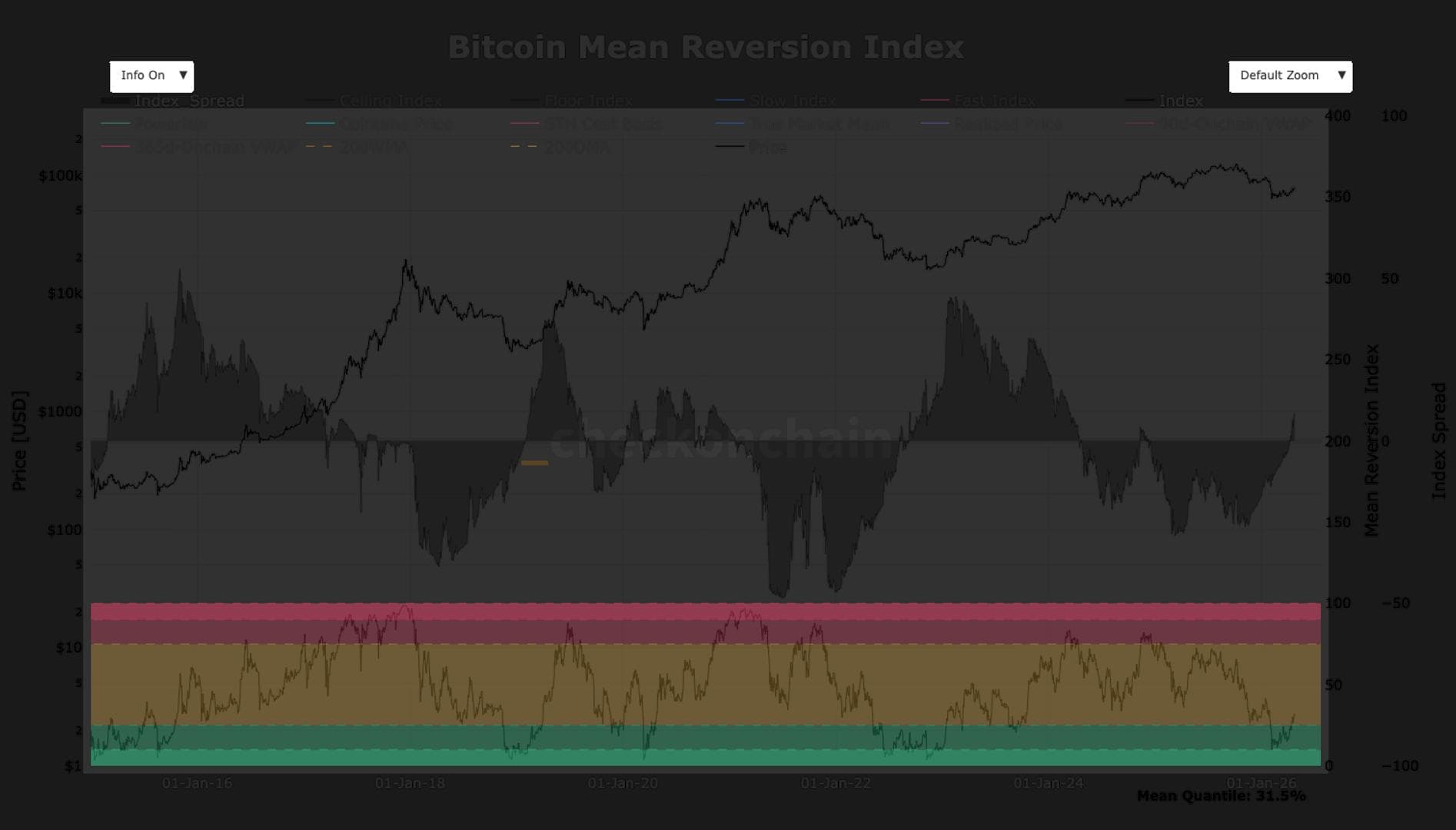
In a cryptocurrency market characterized by its volatility and constant scrutiny, projections on the price of Bitcoin (BTC) are subject to rigorous analysis. Recently, a study based on mean reversion models has shed light on the improbable occurrence of an extreme bearish scenario for the leading cryptocurrency.
Mean Reversion Analysis and Its Implications
Mean reversion models are analytical tools widely used in financial markets to predict price movements. These models are based on the premise that asset prices, over time, tend to revert to their historical average or intrinsic value. In the context of Bitcoin, these models seek to identify significant deviations from its long-term trend, suggesting potential corrections or returns to normalcy.
According to the analysis cited by CoinDesk, the application of these models to Bitcoin reveals that a fall to the $40,000 threshold would be an event of remarkable statistical rarity. This type of prediction differs from simple market speculation, as it is based on the mathematical probability of historical movements.
The Improbability of the $40,000 Threshold
The study details that a decline of Bitcoin to $40,000 would be classified as a 0.4 percentile event. To put this into perspective, a 1 percentile event means there is only a 1% chance of it occurring. A 0.4 percentile indicates an even lower probability, placing this scenario far below the market corrections considered "typical" or even "severe" within Bitcoin's history. This suggests that, from a purely statistical perspective, a correction of this magnitude would be almost unprecedented in the asset's trajectory.
Historical Context and Future Projections
Throughout its history, Bitcoin has experienced boom and bust cycles, with significant corrections that have often tested investor resilience. However, most of these corrections have remained within certain statistical ranges. The notion that a drop to $40,000 is so far outside these ranges underscores Bitcoin's perceived statistical robustness at the time of the analysis.
This type of analysis does not eliminate the possibility that external events or "black swans" could drastically influence Bitcoin's price. Nevertheless, it offers a valuable perspective based on internal market dynamics and historical behavior, providing investors and observers with a more solid foundation for evaluating extreme downside risks.
In summary, while the cryptocurrency market remains unpredictable, data suggests that expectations of a significant drop to $40,000 for Bitcoin should be viewed with a high degree of statistical skepticism, marking it as an atypical and almost unprecedented outcome.
Market Sentiment: Neutral ➡️
Support independent journalism 💸
The crypto ecosystem is volatile. If you decide to invest, do it safely using our affiliate links in the most trusted exchanges. You get a welcome bonus and we get a small commission.
Disclaimer: This content is not financial advice. Do your own research before investing.