The Technical Legacy of Apple's Autonomous Car Project: The Genesis of Its High-Performance AI Chips
Apple's discontinued autonomous vehicle program, Project Titan, demanded unprecedented on-device artificial intelligence (AI) processing. This necessity spurred the internal development of highly efficient chip architectures, laying the groundwork for the AI capabilities in current Apple Silicon, providing a competitive edge in performance and privacy across its products.
By Carlos "Emérito" López Lovera•12 jul 2026•3 min read
Key Takeaways
- The real-time AI processing requirement for Apple's autonomous car project was the catalyst for developing its powerful AI-capable chips.
- Investment in this program, while not yielding a commercial vehicle, translated into a strategic advantage in System-on-a-Chip (SoC) design with advanced Neural Processing Units (NPUs).
- The resulting chips now power AI features in devices like iPhone, iPad, and Mac, offering superior on-device processing that enhances performance, energy efficiency, and user privacy.
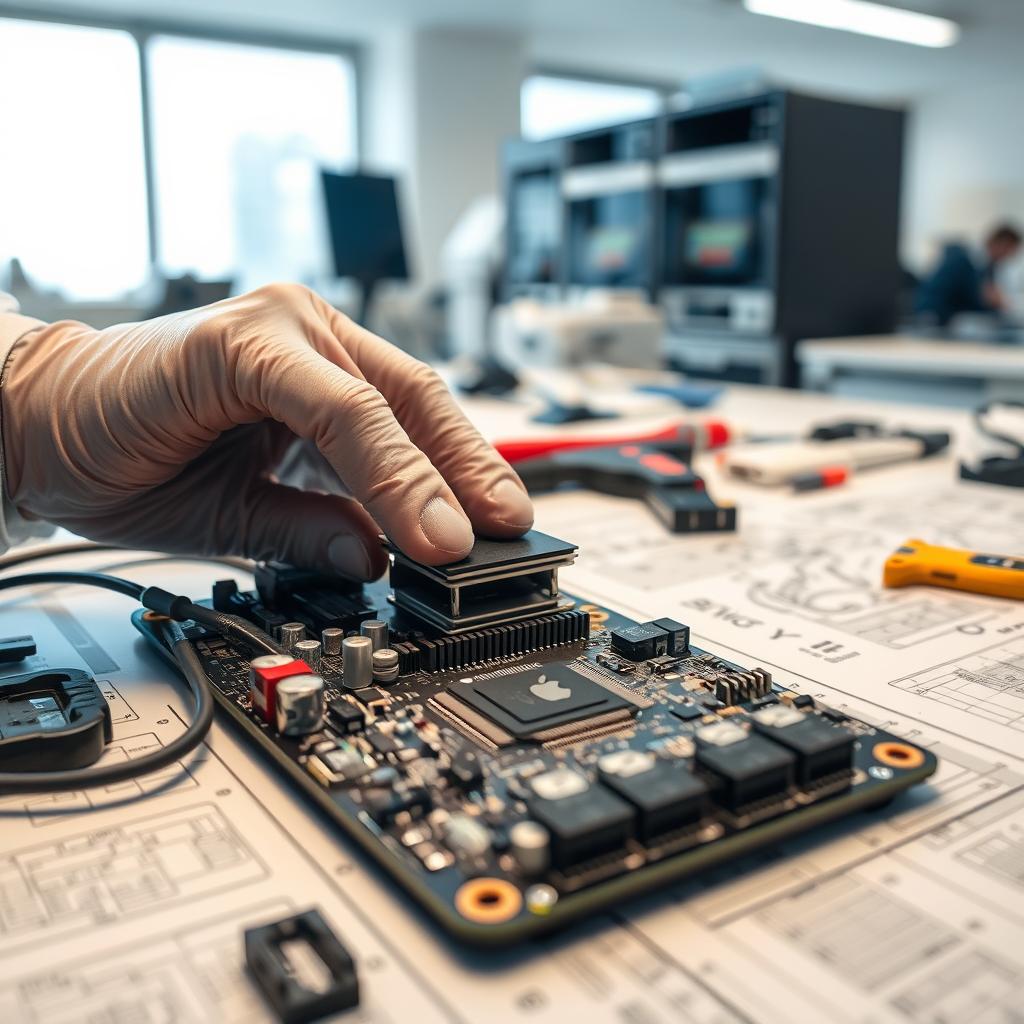
Apple's autonomous vehicle program, internally known as Project Titan, did not culminate in a commercial product. However, its development generated a significant technical consequence: the evolution of artificial intelligence (AI) processing capabilities in the company's chips. The need for robust and efficient AI processing directly on the device for the operation of an autonomous vehicle was a critical factor.
Origin of Apple's AI Processing Requirement
The operation of an autonomous vehicle demands the ability to process large volumes of sensor data in real-time. Cameras, LiDAR, radar, and other systems generate streams of information that must be instantly interpreted for object detection, trajectory prediction, and navigation decision-making. This complexity required a computing architecture capable of executing AI models locally, with minimal latency and maximum energy efficiency. Reliance on the cloud for these critical operations was not viable due to connectivity limitations and security requirements.
Development and Evolution of Chip Architecture
Investment in Project Titan compelled Apple to internally develop dedicated AI hardware solutions. This effort resulted in the integration of advanced Neural Processing Units (NPUs) within its System-on-a-Chip (SoC) designs. These NPUs are optimized for machine learning workloads, enabling parallel and efficient execution of neural network algorithms. The expertise gained in designing chips capable of handling the demanding autonomous driving environment laid the groundwork for the 'Neural Engine' present in A-series chips and, subsequently, in the Apple Silicon family (M-series).
Technical Implications and Competitive Advantage
The resulting chip technology has been reoriented towards Apple's main product line. iPhone, iPad, and Mac directly benefit from these on-device AI capabilities. This manifests in improvements in areas such as computational photography (e.g., Deep Fusion, Smart HDR), voice recognition (Siri), augmented reality (AR), and machine learning features in applications. Local AI processing not only enhances performance and speed but also strengthens user privacy, as data is processed on the device without needing to be sent to external servers. This hardware capability provides Apple with a distinct competitive advantage over other manufacturers who rely more on cloud-based AI or chips less optimized for on-device machine learning tasks.
Economic and Strategic Impact
Although Project Titan did not yield a consumer vehicle, the R&D investment has produced a strategic return in the form of core chip technology. This development has strengthened Apple's hardware ecosystem, differentiating its products and enabling new functionalities. Apple's ability to design its own SoCs with integrated NPUs reduces reliance on external suppliers and optimizes software and hardware integration, resulting in greater cost efficiency and full control over system performance. This approach favorably positions Apple for future AI innovations, particularly in the realm of edge computing.
The continuous advancement in the efficiency and capability of Apple's AI chips, directly influenced by the requirements of its autonomous vehicle program, sets a benchmark for the industry. The evolution of these hardware architectures will continue to be a critical factor in the performance and differentiation of the company's future products, as well as in the overall direction of on-device AI development.
📖 Key Terms Glossary
❓ Frequently Asked Questions
What was the main impact of Apple's autonomous car program?
The primary impact of Apple's autonomous car program was to drive the internal development of high-performance chips with advanced on-device AI capabilities, which are now fundamental to its existing products.
What implications does this have for current Apple products?
The chip architectures developed for the autonomous car significantly enhance AI performance in iPhone, iPad, and Mac, enabling advanced features in image processing, speech recognition, and augmented reality experiences with greater efficiency and privacy.
What is on-device AI processing?
On-device AI processing refers to the execution of artificial intelligence algorithms directly on the device's hardware, rather than relying on cloud services. This offers advantages in terms of latency, data privacy, and energy efficiency.
Support independent journalism 💸
The crypto ecosystem is volatile. If you decide to invest, do it safely using our affiliate links in the most trusted exchanges. You get a welcome bonus and we get a small commission.
Disclaimer: This content is not financial advice. Do your own research before investing.