Two Decades of Dark Reading: The Critical Evolution of Cybersecurity and Its Implications
Dark Reading's 20th anniversary marks a cybersecurity milestone, reflecting the sector's transformation from basic perimeter protections to advanced AI-driven architectures. This analysis details technical evolution, the multi-billion dollar economic impact of threats, and defensive strategies adapted to an expanding risk landscape.
Key Takeaways
- Dark Reading's 20-year trajectory serves as a key indicator of the rapid and complex evolution of the cybersecurity industry.
- The sector has transitioned from perimeter defenses to Zero Trust models and EDR/XDR solutions, with AI playing a dual role in enhancing defense and increasing attack sophistication.
- The economic impact of cybersecurity is evident in a multi-billion dollar market, rising costs from data breaches, and a global shortage of specialized talent.
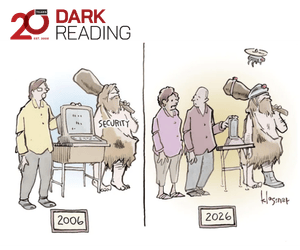
Dark Reading's 'Name That Toon' contest announcement, commemorating its 20th anniversary, transcends a mere promotional event. This milestone underscores two decades of critical evolution in the global cybersecurity landscape and the role of specialized media in disseminating technical knowledge.
Two Decades of Cybersecurity: A Paradigm Shift
Since its inception, Dark Reading has documented the transition from a relatively rudimentary digital environment to a highly sophisticated threat ecosystem. In the early 2000s, cybersecurity predominantly focused on perimeter protection using firewalls and basic antivirus software. Threats were primarily computer viruses and spam, with a limited economic impact compared to today.
The proliferation of broadband internet, the massive adoption of mobile devices, cloud computing, and the interconnectedness of the Internet of Things (IoT) have exponentially expanded the attack surface. This growth has been accompanied by the emergence of complex threat actors: organized cybercrime groups, nation-state-sponsored entities, and hacktivists. The nature of attacks has evolved from isolated incidents to persistent campaigns and supply chain attacks, such as SolarWinds or Log4j, which demonstrate the interdependence and vulnerability of the global digital ecosystem.
Throughout this period, Dark Reading has provided technical analyses, threat research, and trend coverage, consolidating its position as an essential source for security professionals. Its longevity reflects the constant demand for reliable information in a rapidly changing field.
Technical Implications and Defensive Evolution
The technical response to these threats has undergone a radical transformation. The "trust, but verify" security model has been replaced by Zero Trust architectures, which assume breach and verify every access and transaction. Detection and response solutions have become more sophisticated with the advent of EDR (Endpoint Detection and Response) and XDR (Extended Detection and Response) systems, which integrate telemetry from multiple control points for holistic visibility and automated response.
Artificial intelligence (AI) and machine learning (ML) are now integral components in both defense and offense. In the defensive realm, AI is used to detect anomalies, predict attacks, and automate SOC (Security Operations Center) tasks. However, adversaries also employ AI to generate polymorphic malware, conduct more convincing phishing attacks, and automate vulnerability exploitation. The cyber arms race has accelerated with the integration of these capabilities.
Identity and Access Management (IAM), Application Security (AppSec), and Cloud Security Posture Management (CSPM) have evolved from niche areas to fundamental pillars of any enterprise security strategy. Cyber resilience, which includes the ability to recover quickly from an attack, is as critical as prevention.
Economic Impact and Market Outlook
The global cybersecurity market has experienced exponential growth. From a niche sector, it has transformed into a multi-billion dollar industry, with projections exceeding $200 billion annually. This growth is driven by enterprise digitalization, the increasing sophistication of threats, and an increasingly strict regulatory environment (e.g., GDPR, CCPA, NIS2), which imposes significant penalties for non-compliance and data breaches.
The economic costs of cyberattacks are substantial. Data breaches not only entail direct financial losses from operational disruption, remediation, and fines but also damage to reputation and customer trust. Ransomware, in particular, has become a lucrative threat for cybercriminals, with ransom demands often sought in cryptocurrencies such as Bitcoin (BTC) or Ethereum (ETH) due to their pseudonymity and ease of international transfer. This has generated significant illicit economic flow and elevated the profile of cybersecurity as a top-tier business risk.
The global shortage of cybersecurity talent is another critical economic factor, driving up salaries and the demand for qualified professionals. Organizations are increasingly investing in training and retaining personnel, recognizing that the 'human factor' is both a vulnerability and an essential line of defense.
Outlook
The future of cybersecurity will be characterized by an intensified AI-driven arms race, the emergence of quantum threats, and the growing complexity of the attack surface with the adoption of technologies like Web3 and metaverse environments. Continuous monitoring of security innovations, proactive adaptation to new attack methodologies, and investment in operational resilience will be critical checkpoints for the digital survival and prosperity of organizations.
📖 Key Terms Glossary
❓ Frequently Asked Questions
How has cybersecurity evolved over the last two decades?
Cybersecurity has evolved from a focus on perimeter protection with firewalls and antivirus to advanced architectures like Zero Trust, EDR/XDR, and the integration of AI/ML to confront sophisticated threats in an expanded digital ecosystem.
What are the main economic implications of current cybersecurity?
Economic implications include a multi-billion dollar global market, rising costs from cyberattacks (including cryptocurrency ransom demands for ransomware), and a critical shortage of specialized talent that drives up salaries and training investment.
What role does artificial intelligence play in modern cybersecurity?
AI is fundamental for both defense (anomaly detection, attack prediction, SOC automation) and offense (polymorphic malware generation, advanced phishing), intensifying the cyber arms race.
Support independent journalism 💸
The crypto ecosystem is volatile. If you decide to invest, do it safely using our affiliate links in the most trusted exchanges. You get a welcome bonus and we get a small commission.
Disclaimer: This content is not financial advice. Do your own research before investing.