Cloud Cybersecurity for Enterprises in the AI Era: Risk Analysis and Strategies
A Dark Reading virtual event focused on cloud asset security in the AI era highlights the increasing complexity and inherent challenges in protecting enterprise infrastructures. The convergence of cloud computing and artificial intelligence introduces new attack vectors and necessitates a rethinking of defense strategies.
By Carlos "Emérito" López Lovera•5 sept 2026•4 min read
Key Takeaways
- The integration of Artificial Intelligence (AI) into business operations and cloud infrastructures amplifies the attack surface and complicates risk management.
- Securing cloud assets against AI-powered threats demands the implementation of advanced solutions, including AI-driven security tools and robust Identity and Access Management (IAM) policies.
- Companies must adopt a proactive and adaptive approach to mitigate emerging risks, considering the technical and economic implications of security breaches in hybrid and multi-cloud environments.
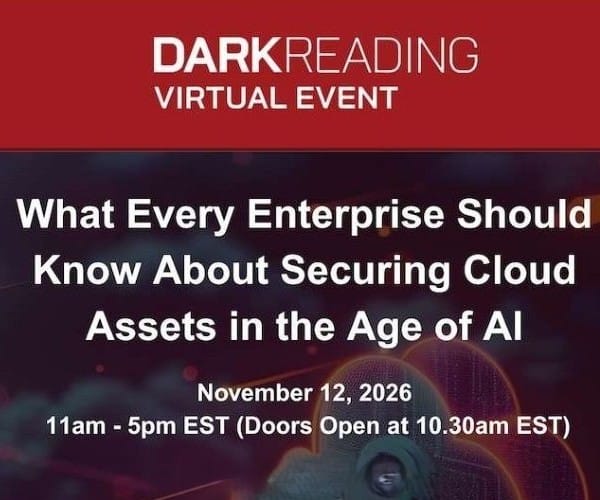
The announcement of Dark Reading's virtual event, titled 'What Every Enterprise Must Know About Cloud Asset Security in the AI Era,' scheduled for September 5, 2026, highlights a critical concern in the current enterprise cybersecurity landscape. This focus underscores the intersection of two transformative technologies: cloud computing and Artificial Intelligence (AI), and their direct implications for organizations' security posture.
The Convergence of Cloud and AI: A New Risk Paradigm
The widespread adoption of cloud services has redefined companies' IT infrastructure, offering scalability and flexibility. However, this transition has also expanded the potential attack surface. The migration of data and applications to public, private, and hybrid cloud environments introduces complexities related to visibility, control, and regulatory compliance. Simultaneously, AI is being integrated into various business facets, from process optimization to data analysis and automation. While this integration drives efficiency, it also presents new threat vectors.
The 'AI era' refers not only to the use of AI by businesses but also to its exploitation by malicious actors. Adversaries can employ AI and machine learning algorithms to develop more sophisticated and adaptive attacks. This includes the generation of polymorphic malware, highly personalized phishing attacks (spear-phishing), and the automation of reconnaissance and vulnerability exploitation processes. The speed and scale at which AI can operate surpass the capabilities of manual or traditional signature-based defense methods.
Technical Challenges in Protecting Cloud Assets
Protecting cloud assets in this context involves addressing multiple layers of security. First, Identity and Access Management (IAM) becomes fundamental. With the proliferation of user and machine identities in the cloud, ensuring that only authorized entities have access to the appropriate resources is a constant challenge. AI can be used to detect anomalies in access patterns, but it can also be exploited to bypass authentication controls.
Second, data protection is paramount. Data stored and processed in the cloud is the primary target of many attacks. This requires not only robust encryption in transit and at rest but also the implementation of Data Loss Prevention (DLP) policies and the ability to monitor and audit data access in real-time. AI can assist in data classification and exfiltration detection, but the introduction of AI models into sensitive data processing also raises concerns about privacy and model integrity.
Third, cloud configuration security is a critical point. Misconfigurations are one of the leading causes of cloud security breaches. The complexity of multi-cloud environments and rapid development and deployment cycles can lead to human errors. AI-powered cloud security tools can automate the identification of deviations from security policies and the enforcement of correct configurations, but their effectiveness depends on the accuracy of their models and the constant updating of their knowledge bases.
Economic and Strategic Implications
The economic implications of an AI-powered cloud security breach can be devastating. Beyond direct remediation costs, these include regulatory fines (especially under regulations like GDPR or CCPA), reputational damage, business interruption, and litigation. Investment in cybersecurity, particularly in solutions that leverage AI for defense, becomes a strategic imperative rather than a discretionary expense.
Companies must develop a comprehensive security strategy that considers AI both as a threat and a defensive tool. This involves continuous staff training, the implementation of 'zero trust' security architectures, the adoption of Cloud Workload Protection Platforms (CWPP) and Cloud Security Posture Management (CSPM), and the integration of AI-based threat intelligence. The ability to anticipate and respond to sophisticated attacks will be a key differentiator in business resilience.
Dark Reading's event for 2026 signals the persistence and evolution of these challenges. Organizations will need to continuously evaluate their security frameworks, investing in technologies and processes that enable adaptive defense against a constantly changing threat landscape, where AI plays a central role on both sides of the cybersecurity equation.
📖 Key Terms Glossary
❓ Frequently Asked Questions
What is the main cloud security concern in the AI era?
The main concern is the expansion of the attack surface and the sophistication of threats, as AI can be used by malicious actors to create more complex and adaptive attacks, while companies integrate AI into their cloud operations.
How does AI impact cloud cybersecurity strategies?
AI impacts strategies by requiring more advanced security solutions that also leverage AI for anomaly detection, identity management, and data protection, overcoming the limitations of traditional defense methods against automated attacks.
What specific technical challenges do companies face?
Challenges include Identity and Access Management (IAM), protecting sensitive data in transit and at rest, and securing cloud configurations, where errors can be exploited by AI-powered threats.
Support independent journalism 💸
The crypto ecosystem is volatile. If you decide to invest, do it safely using our affiliate links in the most trusted exchanges. You get a welcome bonus and we get a small commission.
Disclaimer: This content is not financial advice. Do your own research before investing.